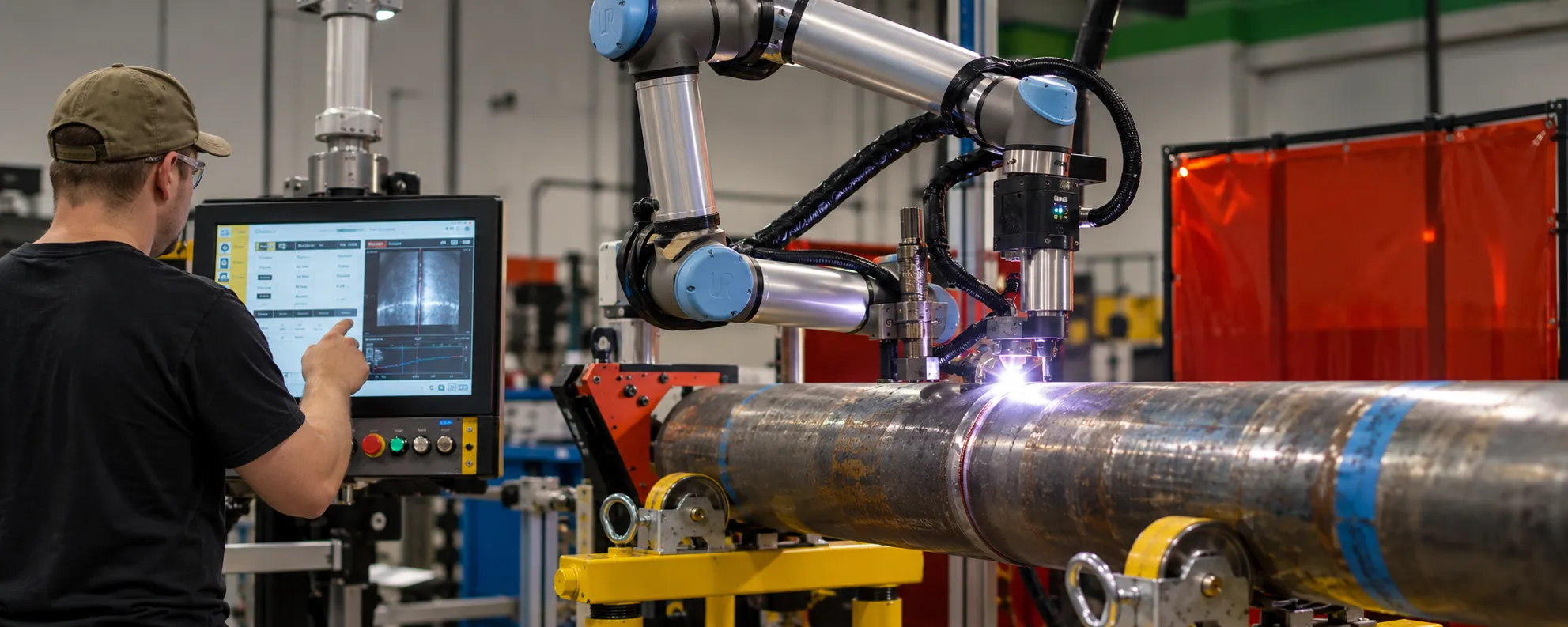
Walk onto a modern fabrication floor and you might see something that would have looked out of place a decade ago. A robotic arm welding a part with no safety cage in sight, and a technician standing close by, unbothered. That robot is very likely a welding cobot. As more shops face a shrinking pool of experienced welders, cobot welding has become one of the fastest growing answers to the labor gap. This guide covers what cobot welding actually is, how it works, and where it fits alongside other forms of welding automation.
What Is Cobot Welding?
Cobot welding is the use of a collaborative robot, or cobot, to perform welding tasks such as MIG, TIG, or arc welding. The word cobot comes from combining collaborative and robot, and it describes exactly what makes this technology different from older industrial robots. A welding cobot is built with force limiting joints and sensors that let it operate safely in the same space as a person, without the safety fencing that traditional robotic welders require.
In practice, a welding cobot pairs a lightweight robotic arm with a welding power source, a torch, a wire feeder, and software that lets an operator program weld paths without writing code.
How Does a Welding Cobot Work?
A complete welding cobot setup usually includes four main pieces:
The robotic arm: Typically a six axis arm with a payload under 20kg, built with torque sensors in the joints that detect resistance and trigger an immediate stop if the arm contacts a person.
The welding package: A power source, torch, and wire feeder matched to the welding process, whether that is MIG, TIG, or another arc welding method.
The programming software: A visual interface that lets an operator create and edit weld paths through drag and drop controls, or by physically guiding the arm through the path one time.
Safety sensors: Built in systems that monitor speed, separation, and contact so the cobot can share space with a human operator without a physical barrier.
Most cobots support a teaching method called drag and teach, where an operator physically moves the arm through the weld path once, and the software records it. This is a large part of why cobot welding has such a short learning curve compared to traditional robotic programming.
Cobot Welding vs. Traditional Robotic Welding
| Factor | Traditional Robotic Welder | Welding Cobot |
| Safety Setup | Requires fencing and light curtains | Works alongside people, no cage needed |
| Best Fit | High volume, low mix production | High mix, low volume, flexible jobs |
| Typical Cost | $80,000 and up for a full cell | $20,000 to $60,000 for a full package |
| Programming | Specialist staff, offline CAD software | Drag and teach, a few hours to learn |
| Deployment Time | Days to weeks for first part | Hours to a day for first part |
| Payload and Reach | Higher, built for heavy tooling | Lighter, typically under 20kg payload |
The biggest difference comes down to how each system fits into a shop’s workflow. Traditional robotic welders are built for speed and volume, and they usually make the most sense when a shop is running the same part over and over at scale. Welding cobots trade some of that raw speed for flexibility, safety, and a much lower barrier to entry, which is exactly why they have found such a strong footing in high mix, low volume production and in smaller shops that could never justify a full robotic cell.
Why Shops Are Adopting Cobot Welding
The single biggest driver behind cobot welding adoption is the ongoing shortage of skilled welders. Industry estimates point to a shortfall of several hundred thousand welders in the coming years, and that gap is pushing shops of every size to look at automation options that used to be reserved for large manufacturers.
Cobots lower that barrier in a few concrete ways. The upfront cost is a fraction of a traditional robotic cell. The setup does not require rebuilding a work cell around safety fencing. And the programming can be handled by an experienced welder after a short training period, rather than requiring a dedicated robotics programmer on staff.
Beyond labor, cobot welding also improves consistency. A programmed weld path repeats the same travel speed and arc parameters every time, which reduces the variation you get from welder fatigue over a long shift.
Where Cobot Welding Fits Best
Cobot welding tends to shine in a specific set of conditions:
• High mix, low volume work, where part designs change often and full robotic tooling would not pay for itself
• Smaller shops that want to start automating without a large capital outlay
• Repetitive joints that are physically tiring or awkward for a welder to run manually all day
• Labor constrained operations that need to get more output from a limited welding staff
It is worth noting that cobot welding is one part of a much larger picture of welding automation. Many shops run cobots alongside other automated systems, including automated pipe and tube welding equipment for the joints where precision and repeatability matter most. If you want to see how a different form of automated welding compares, our guide on
orbital welding covers how that process automates pipe and tube joints specifically, and how it stacks up against manual welding in our related comparison on orbital welding vs. manual welding.
Cobot Welding Services at SEC Automation
SEC Automation offers cobot welding as part of our automated welding services, built for shops that need flexible, fast to deploy automation without the cost and footprint of a full robotic cell. Our team handles the full setup, from selecting the right arm and payload for your parts to programming the first weld paths alongside your operators, so your shop is running production quickly rather than spending weeks on integration.
If your shop is dealing with a high mix of small to mid volume parts, inconsistent weld quality across shifts, or simply cannot find enough skilled welders to keep up with orders, cobot welding is one of the fastest ways to close that gap without a major capital investment.
Common Questions Shops Ask Before Buying
Most shops considering a welding cobot want to know three things before committing. First, will it actually handle our part mix, which usually comes down to reach, payload, and the range of welding processes the system supports. Second, how long will it take our team to get productive, which is typically measured in hours rather than days for cobots. Third, what is the real total cost of ownership once training, tooling, and maintenance are factored in, not just the sticker price of the arm itself.
Getting straight answers to those three questions before purchase is the best way to avoid buying more automation than a shop actually needs, or under buying and hitting a capacity wall within the first year. This is exactly the conversation our team has with every shop before recommending a specific cobot welding setup.
Get Started with Cobot Welding
Whether cobot welding, orbital welding, or a combination of both fits your shop depends on your part mix, volume, and current labor situation. Our team at SEC Automation works with fabrication shops every week to figure out where automation makes the biggest difference first, based on real production data rather than a generic recommendation. Our M3 pipe spool welder and broader automated welding equipment lineup are built for exactly this kind of production, and our cobot welding service is a natural extension for shops that need that added flexibility.
Ready to see if cobot welding is the right fit for your shop? Request a cobot welding consultation and our team will walk through your parts, volume, and timeline to recommend the right setup.
| FREQUENTLY ASKED QUESTIONS |
▸ What is cobot welding?
Cobot welding uses a collaborative robot, a robotic arm designed with sensors and force limiting technology, to perform MIG, TIG, or arc welds while working safely alongside human operators without a safety cage.
▸ How is a cobot different from a traditional welding robot?
Traditional welding robots run at high speed behind safety fencing and are built for high volume production. Cobots run slower, include built in safety sensors, and are designed to work in the same space as people, which makes them a better fit for smaller shops and mixed production runs.
▸ How much does a welding cobot cost?
A complete welding cobot package, including the robot arm, power source, torch, and programming software, typically runs between twenty thousand and sixty thousand dollars depending on payload, reach, and welding process.
▸ Do I need programming experience to use a welding cobot?
No. Most welding cobots use drag and teach or visual programming interfaces, so an experienced welder can typically learn to program new weld paths within a few hours rather than the days required for traditional robotic systems.
▸ Is cobot welding a good fit for a small fabrication shop?
Yes, in many cases. Cobots are well suited to high mix, low volume work, which is common in small shops, and the lower upfront cost compared to traditional robotic cells makes incremental automation more accessible.